
Can you use a power hand planer on a large board? There are a few steps you can take to do this:
There are many tasks you can accomplish with a power hand planer. These versatile tools are great for creating borders on wood, smoothing uneven surfaces, and refining handrails. Skilled users can also use them to modify the edges of entryways with precision. If you are working on a larger project, such as smoothing wide boards, it is essential to know how to use a power hand planer on wide boards. Follow these steps to achieve a smooth and professional finish:
How To Use a Power Hand Planer on Wide Boards? Step By Step guide
Table of Contents
- Setting Up the Board
The first thing to do when using a small power planer on a wide board is to set up the load properly. First, find a flat area that is larger than the board you are going to use. To ensure that the wood is stable while you are cutting, use raised areas to give the board the necessary support. If it is known to be correct, place the board. This is done to raise the board or to ensure that it has a curve to keep the wood stiff. Another important step is to use a stamping gauge to mark the high points of the board by making lines around the board. This is done to make the board even from start to finish so that no side is higher than the other.
- Force the board to be flat
This step-by-step guide shows you how to use a power hand planer to finish cutting the board to the lines you made in the previous step. This also involves using a winding stick to change the board to the desired “level” side. It’s best to smooth large sheets in stages, as this allows you to release the pressure inside the wood and slightly change its shape. Ideally, you should try to cut off about 75% of the wood on each side that you need to shave.
- Mark and Mark the High Spots
To get a flat surface with a power hand planer, you first need to mark the high spots. A straightedge and a pencil are the best tools for this job. To do this, draw a line across the board and mark each high spot where the line meets the board. Once you know where the high spots are, you can start working with your electric planer.
First, set the depth of cut so that it is approximately the same thickness as the board. Once you have both hands on the planer, slowly move it along the length of the board, making sure to remove material evenly from all the high spots. After some practice, you will be able to create a flat surface that is ready for edging and finishing.
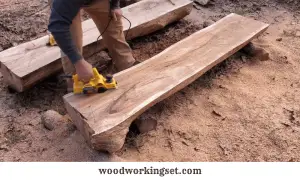
4. Plane the Wood
You can plan wood with a power hand planer. The power hand planer allows you to change the cutting level according to your needs. The wood can be planed to a depth of 6 to 8 mm. The power hand planer can be held in one hand or used on large boards. Time and energy are used very well by the power hand planer. This can help you save time and energy. This power hand planer is very simple and easy to care for. The power hand planer is very light, so it is easy to move from one place to another.
- Give the board time to settle
Hold your board for two or three hours before turning it on again. This way, you will let the board settle before smoothing it. In most cases, those who are using the power hand planer on a wide load are eager and should skip this step. There is a possibility that this process can be avoided, but by leaving the load on itself for a few days, you are doing yourself a huge favor. This will allow the board to sink into its shape completely. Taking a break from the workshop is also very important, and it will give you that. You can use this crush to regain the strength and health that you lost from sawing wood all day.
- Sand the board
Once you are done sanding the board, you should sand it. This step is not necessary, but if you don’t, all your hard work may be in vain. You can be sure that if you sand it, your board will look and feel better than anyone could have imagined. It is recommended to purchase and use a wide-belt sander to get a near-perfect finish on your board. A belt sander can be used instead of a sander to ensure that the end result of your project is very smooth.
Should I get a planer or a jointer?
A power tool called a planer is used to shape and round wood. It has several wheels that rotate around a blade that is held in place. As the wood moves between the wheels and the blade, the planer cuts it.
A jointer is a power tool used to straighten the edges of wooden boards. There are two blades on each side of the board. They are angled so that they cross each other. The wood is cut as it passes through the jointer’s blades.
You need both of these tools to make furniture, but if you choose your boards carefully, you can work with just a planer.
Can you use a thickness planer as a jointer?
It is possible to join with a thickness planer, but the result will not be as smooth.
Before placing the board on the thickness planer to use as a jointer, you should make sure that the entire surface is flat. You can use a handheld belt sander or cutter and straight edge to do this. You should also use a handheld router or knife to remove any small knots or other imperfections in the wood.
How do you plane a wide board with a handheld plane?
There are several ways to use a hand plane to smooth a wide board. To start, you can smooth the board with 80-grit sandpaper to remove any bumps. Next, level the surface with a block plane. You can still smooth out any bumps or curves using a belt sander. Be careful not to sand the board too much, or the surface will become thin and warped. Once level, you can begin to plane the board to your desired width.
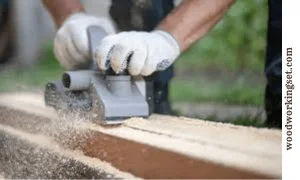
Using an electric hand planer
When working with wide boards, an electric hand planer can make all the difference. You can smooth rough surfaces, trim edges, and create perfectly flat surfaces with these powerful tools. But you need to know how to use them to get the most out of them. To help you learn how to use a power hand planer on wide boards, this section will walk you through several steps.
Before you start any work with an electric hand planer, make sure you have the right safety equipment. This means wearing safety glasses to protect your eyes from moving objects and earplugs to protect your ears from the loud noises these tools make. Also, never put your hands near the cutting edge and never reach over or over it while it is running.
Frequently Asked Questions
How do I use a power hand planer on wide boards?
Here’s how to use a power hand planer on large boards:
Step 1: Make sure you have enough space to set up your workspace and a stable surface to work on.
Step 2: For better control and speed, use a hand-held power planer or an electric hand planer.
Step 3: You’ll need to adjust the depth of your planer’s blade to get the board to your desired thickness.
Step 4: Start at one end of the wide board and hold the planer firmly with both hands.
Step 5: Move the planer slowly and smoothly along the length of the board, applying even pressure.
Step 6: Continue this step until you’ve planed the entire width of the board.
Step 7: Look for any bumps or other imperfections on the surface of the board, and if you find any, use the planer to correct them.
Step 8: Once you’re happy with how smooth and even the board is, you can start finishing or further woodworking.
What is a power hand planer?
It is also called an electric hand planer or a small power planer. A power hand planer is a tool that is used to cut material and smooth the surface of a board.
It is small and easy to carry, and its spinning blades can be used to quickly and easily remove thin layers of wood. This allows you to shape and smooth the boards.
What are the advantages of using a power hand planer on wide boards?
There are several advantages to using a power hand planer on wide boards:
Efficiency: It allows you to quickly remove material from the surface of the board, which saves time compared to hand cutting.
Control: You have more control over the planing process with a power hand planer, so the results are more even and uniform.
Versatility: It can be used on a variety of types of wood, even wide boards, so it can be used for a variety of woodworking tasks.
Ease of use: Power hand planers are easy to use, even for beginners, as they have ergonomic handles and settings that are easy to understand.
In conclusion:
This is how you use a power hand planer on large boards. Don’t rush this process or anything else. This method involves pulling and pulling at night. Your slightly frustrated attitude can also have a bad effect. You can try this method in different ways. You may need to use tools that stay in one place. However, for some jobs, the guards will need to be lowered. This can be dangerous because it can cause sudden injuries. Also, your surface finish may be rough. So be sure to choose your method, tools, workspace, and safety devices carefully. If you follow the steps carefully, the process will go smoothly.
- WoodRiver Plane reviews | Best Wood Hand Planer In 2024 - 19/10/2024
- The Best Tung Oil: The Ultimate Guide in 2024 - 19/10/2024
- 12 Inch Wood Planer: Smooth Your Woodworking Projects Like a Pro - 01/10/2023